


Well Water Filtration Systems: A Complete Guide by Contaminant Type

If your home runs on a private well, clean water is entirely up to you. Well water never passes through a municipal treatment plant, so bacteria, iron, sediment, and other contaminants can reach your tap unless you've filtered them out yourself.
More than 13 million U.S. households rely on private wells, and the EPA is clear that well owners — not any government agency — are responsible for their own water safety. The right filtration system depends entirely on what's actually in your water, so the fastest path to a solution is knowing your contaminants first, then matching the system to them.
Common Well Water Contaminants
Well Water Contaminants and How to Treat Them
| Contaminant | How you'll notice it | Treatment |
|---|---|---|
| Iron & manganese | Orange/black staining, metallic taste | Oxidizing or greensand iron filter |
| Hardness minerals | Scale buildup, filmy residue | Water softener - ESP Water does not sell |
| Hydrogen sulfide | Rotten-egg odor | Aeration / oxidizing filter |
| Bacteria & viruses | Often undetectable without testing | UV disinfection |
| Nitrates | Undetectable; risky for infants | Reverse osmosis |
| Sediment & rust | Cloudy water, clogged appliances | Sediment filter |

Test Before You Buy
Testing is the one step that determines everything else. At-home kits give you a quick read on iron, hardness, pH, and bacteria; a certified lab test screens for dozens of contaminants and is worth it if you've never tested or are buying a home on well water. The EPA recommends testing at least once a year for bacteria and nitrates, and again anytime taste, odor, or color changes.
Building a Whole-House System, Stage by Stage
Most private-well setups treat water in a sequence — each stage protecting the one after it.

Sediment filtration goes first, almost always. A sediment filter traps dirt, sand, and rust before it can clog or damage everything downstream and is often paired with a carbon filter to improve taste and odor. Cartridges typically need replacing every 3–6 months.
Iron and manganese removalcomes next if your test shows either mineral. Standard filters can't touch dissolved iron — you need an oxidizing filter, a greensand filter, or an air-injection system to convert it into a solid particle first, then filter it out. Which one depends on whether your iron is dissolved, particulate, or bacterial — your test results will tell you.
Water softening addresses hardness in most whole-house builds, protecting pipes, water heaters, and appliances from scale buildup — and preventing scale from coating a UV quartz sleeve if hardness is high. ESP doesn't sell softeners at this time, but our team can point you to compatible pretreatment options if your test shows elevated hardness.
UV disinfection is the recommended stage if your test has ever shown bacteria or coliform. It's the fastest, most effective way to inactivate biological threats without adding chemicals. Because well water often carries sediment that can shield microorganisms from UV light, a system with integrated prefiltration performs best — which is exactly what the next-generation VIQUA Arros line was built for. For the full picture — how UV works, lamp maintenance, and system comparisons — see our guides to UV water filters for well water, the best UV systems for well water, and our UV buyer's guide.
No existing filtration yet? Start with Arros.
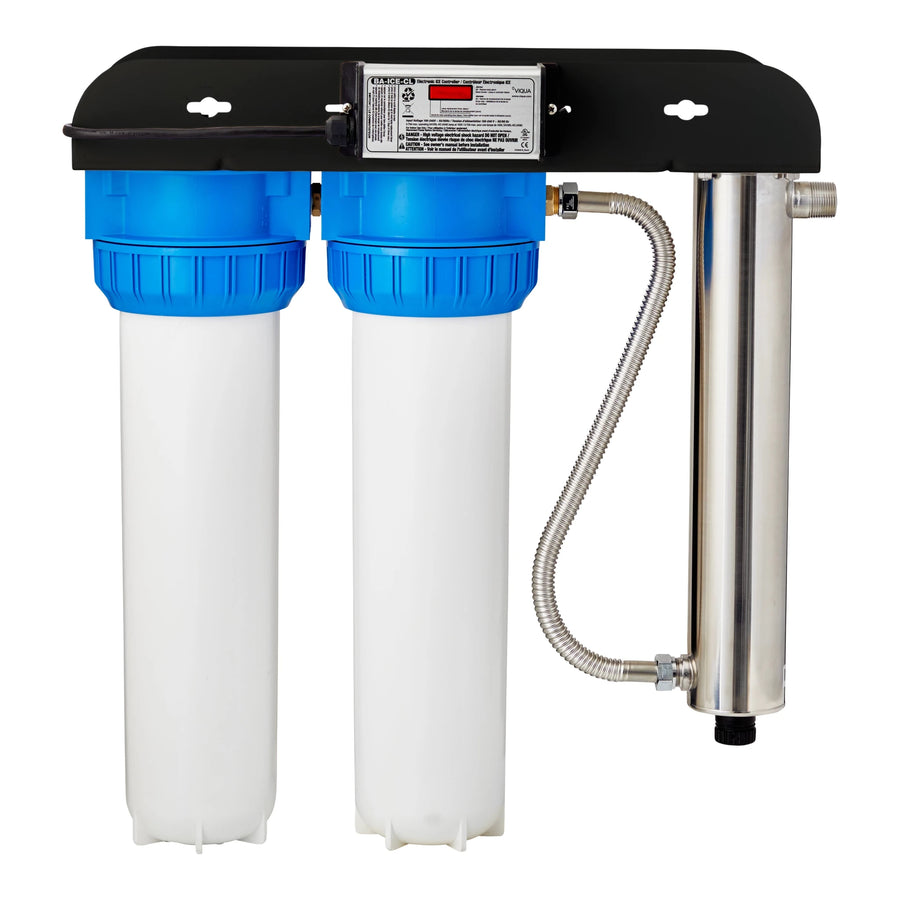
The VIQUA Arros 15-IHS22combines sediment and carbon prefiltration with UV disinfection in one pre-assembled unit — the simplest way for well owners to get whole-house protection without piecing together separate stages. Explore the Arros lineup →

Reverse osmosis is worth adding at the kitchen tap if your test shows multiple contaminants — dissolved solids, heavy metals, nitrates, or fluoride. RO membranes are effective but easily fouled by iron, so it should always sit downstream of iron removal and sediment filtration, not in place of them. See whether a whole-house RO system makes sense for your setup.
Maintenance at a Glance
Keep your well water system performing its best with a simple maintenance schedule. Replace sediment cartridges every 3–6 months, change the UV lamp and clean the quartz sleeve annually, and re-test your well water each year as conditions can change seasonally. Inspect iron filter media once a year and replace it every few years as needed.
Choosing the Right Combination
Start with your test results, not a guess. Iron-heavy water needs oxidation before UV or RO ever see it. Any positive bacteria result makes UV the priority stage. High nitrates point toward a dedicated RO stage. Household size matters too — a larger home needs higher flow rates so pressure doesn't drop when multiple fixtures run at once; our UV system buyer's guide walks through sizing in more detail.
Not sure how your results translate into a system? Talk to an ESP Water specialist — we'll match your test to the right combination of products.
Is Well Water Safe to Drink Without a Filter?
Not automatically. Some wells test clean for years, but flooding, drought, agricultural runoff, or aging well infrastructure can change that without warning. The only way to know is to test — and if bacteria or viruses show up, shocking the well can clear a one-time contamination (followed by retesting to confirm), but UV disinfection is the only way to keep it that way long-term.
Top-Selling UV Water Filter Systems
-
Includes sediment and carbon pre-filters
-
Lamp Life LED Display
-
18 gpm UV for Larger Home

-
UV Dose Sensor
-
Lamp Life LED Display
- 18 gpm Monitored UV

-
Includes Pre-Filter
-
Lamp Life LED Display
-
9 GPM Water Treatment
Frequently Asked Questions
What is the best water filtration system for well water?
It depends on your test results. Most whole-house setups combine a sediment filter, iron/manganese treatment if needed, and UV disinfection for bacteria and viruses — see our top UV picks for well water. Homes with multiple contaminants often add reverse osmosis at the kitchen tap.
How do I know what contaminants are in my well water?
Test it. At-home kits cover the basics (iron, hardness, pH, bacteria); a certified lab test gives a full picture.
Do I need a whole-house filter or a point-of-use filter?
Whole house, for most well owners — iron, sediment, and hardness affect every fixture, not just your drinking tap. A point-of-use RO system is a great addition for drinking water, but it should sit downstream of whole-house pretreatment, not replace it.
Is reverse osmosis good for well water with iron?
Not on its own. Iron fouls an RO membrane quickly, so iron removal has to come first — an oxidizing, greensand, or air-injection filter, followed by sediment filtration. Once iron is handled, RO works well at the kitchen tap. RO isn't a bacteria solution, though: if your test shows coliform, add UV disinfection as a separate whole-house stage.
What's the best UV system if I don't have any other well water filtration installed?
The VIQUA Arros is built for exactly this situation. It pairs integrated sediment and carbon prefiltration with UV disinfection in a single pre-assembled unit, so you get whole-house protection without installing separate stages first.

Reverse Osmosis Technical Tips

How to Change RO Filters
Learn how to replace your RO systems' filters and membrane with step-by-step instructions.
Read More>

How to Install a Reverse Osmosis System
Clear, concise instructions on how to install an under-sink reverse osmosis filtration system yourself.
Read More>

How to Connect an RO System to Fridge or Ice Maker
Tips for connecting your RO system to a refrigerator water dispenser or ice maker. Get step-by-step guidance for optimal results.
Read More>


